The dashboard looks healthy.
We assumed the same about ours.
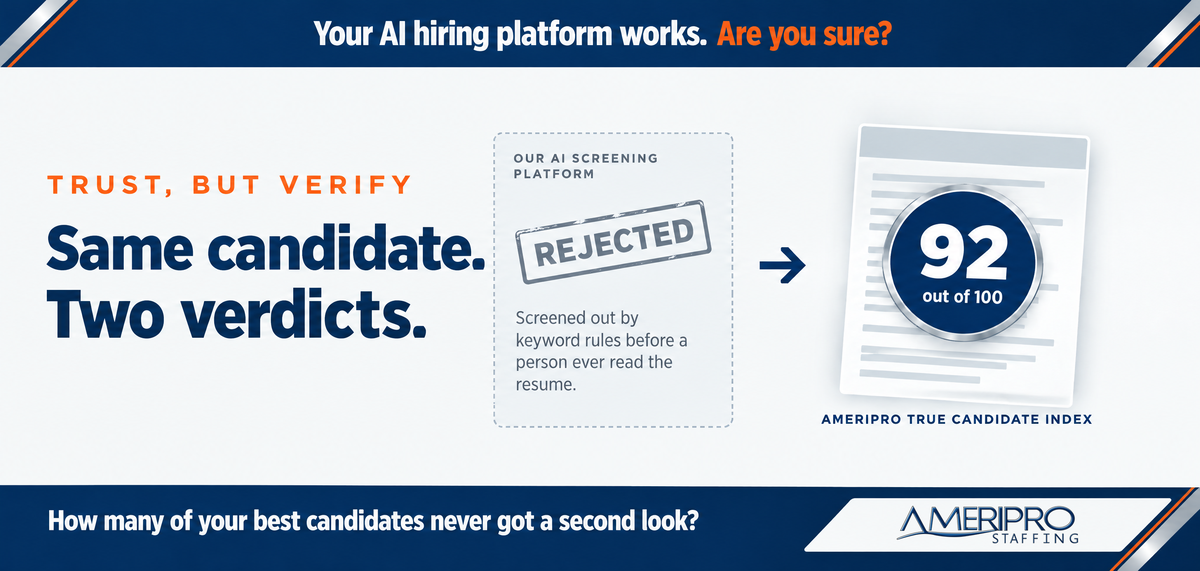
On a recent search, our own AI screening platform rejected a candidate on day one. Our team reviews rejected applicants by hand every other day, and that review flagged the file. After a phone screen and a first interview, the candidate scored 92 out of 100 on the AmeriPro True Candidate Index, the in-house assessment we built to measure every candidate against a client's must-haves, nice-to-haves, core traits and deal-breakers. This candidate met every must-have.
The cause was configuration, not candidate quality. Keyword rules in our own setup excluded a top performer. On the same search, those rules advanced applicants who did not meet baseline requirements, because their resumes and assessment answers contained the right words.
We corrected the setup. We still review the output. That discipline, not the software, is the point of this article.
The plug-and-play assumption
AI recruiting platforms are typically sold as plug and play. The capabilities are real: resume parsing, automated scoring, screening questions, scheduling and candidate communication, all running without a person in the loop.
What the sales process tends to understate is that every one of those capabilities runs on rules someone wrote. Someone defined what "qualified" means, which answers disqualify, which terms score well and where the cutoff sits. In most mid-size companies, that work happened once, during implementation, usually from a job description that predates the platform.
The data bears this out. In a study of more than 2,250 executives, Harvard Business School and Accenture found that 72% of employers reuse existing job descriptions for middle-skills roles, and 94% agree their systems screen out qualified middle-skills candidates for not matching the job description exactly. For high-skills roles, the figure was 88%.
That research predates generative AI. The newer tools have not removed the problem. They add a scoring layer on top of the same rules, at a time when application volume has roughly tripled since 2021, which shifts more of each decision to the machine.
The risk runs in both directions
Most discussion of AI screening focuses on candidates who are wrongly rejected. That is half the exposure. A misconfigured system also advances people who should not get through. The result is a hiring process that fails quietly at both ends:
- Qualified talent never reaches the decision-maker. Nobody sees the rejection, so nobody questions it.
- Weak fits consume management time. Hiring managers interview people who should never have reached them, and some of those people get hired.
- The reporting looks normal. The platform reports "no qualified applicants," and the organization concludes the labor market is the problem.
For an operating company, these are not HR details. They show up as seats open for 60 days or more, overtime for the crews covering them, supervisors promoted before they are ready, and early turnover from hires that should not have been made. A system meant to reduce cost per hire can raise the total cost of hiring while appearing efficient.
Five configuration points that deserve executive attention
- Knockout questions. Yes-or-no questions that end an application immediately. A requirement of five years' supervisory experience eliminates an applicant with four and a half years and a strong record. These questions are rarely revisited after implementation.
- Title and keyword matching. Frontline titles are not standardized. "Warehouse supervisor," "shift lead" and "operations lead" can describe the same job. Military experience translates poorly: a platoon sergeant accountable for 40 people, equipment and safety may match none of the keywords being scored.
- Employment-gap and tenure filters. Many systems exclude or down-rank applicants with gaps in employment. That screens out transitioning veterans, returning parents and people who stepped away to recover or care for family, and it tends to fall harder on older applicants.
- Requirements the role does not need. A degree requirement for a supervisory role that has never needed one. A license requirement carried over from a different job template. A commute radius drawn for a city when the talent lives 35 miles out. Each one narrows the pool without anyone deciding it should.
- Match scores and auto-reject thresholds. Scores built from job descriptions and past hires reward more of the same. When an automatic cutoff is set below a given score, no one reviews what falls beneath it.
A note on legal exposure
Automated screening is also drawing legal scrutiny. A federal lawsuit against Workday, which remains pending and which Workday denies, alleges its AI screening tools discriminated against older, Black, female and disabled applicants; in 2025 the court allowed the age claims to proceed as a nationwide collective action. New York City requires bias audits of automated hiring tools, and several states have passed their own rules.
Companies outside those jurisdictions are not exempt from federal discrimination law, which applies whether a person or a program makes the decision. Filters tied to employment gaps, years of experience or graduation dates warrant careful review with counsel. This article is not legal advice. Consult your employment attorney about how these laws apply to your organization.
Five questions for your leadership team
- None of this requires replacing the technology. It requires governing it. Every leadership team using an AI recruiting platform should be able to answer these questions:
- When was our screening logic last reviewed, by whom, and against which version of the job?
- Of the applicants rejected last month, how many would our best hiring manager have interviewed?
- Are candidates advancing who do not meet our stated minimums?
- Where are our automatic cutoffs set, and does anyone review what falls below them?
- Who owns the output of this system, and how often do they verify it?
If those answers are unclear, the platform is running on assumptions. Reviewing a sample of rejected and advanced applicants for a single critical role usually shows within an hour whether the configuration matches the business's intent.
The bottom line
AI accelerates screening. It does not replace judgment. The organizations that get the most from these platforms treat them as a tool to be governed, not a function to be handed off. They keep a person accountable for the output, and they verify it on a schedule.
If an outside perspective would help, AmeriPro offers a complimentary discovery conversation about where your current platform may be falling short. If useful, we will follow it with a review of your platform's setup: knockout questions, filters, keyword rules and scoring thresholds for one or two critical roles, and where they may be rejecting the right people or advancing the wrong ones. Reply to this newsletter or message us on LinkedIn to arrange a time.
This is an operational review of how your platform is configured. It is not a legal or compliance audit.
#Hiring #Recruiting #HR #SupplyChain
#Leadership
Sources
1. Fuller, J., Raman, M., Sage-Gavin, E., & Hines, K. "Hidden Workers: Untapped Talent." Harvard Business School Project on Managing the Future of Work and Accenture, September 2021.
https://pubwww.hbs.edu/managing-the-future-of-work/Documents/research/Hidden%20Workers%20Executive%20Summary.pdf
2. "How to Tap the Talent Automated HR Platforms Miss." Harvard Business School Working Knowledge, 2021.
https://hbswk.hbs.edu/item/how-to-tap-the-talent-automated-hr-platforms-miss
3. Navarra, K. "Ensure Your Recruitment Tech Isn't Costing You Quality Candidates." SHRM, May 31, 2022.
https://www.shrm.org/topics-tools/news/technology/ensure-recruitment-tech-isnt-costing-quality-candidates
4. Gupta, S. "AI Race: Why More HR Tech May Actually Break the Hiring Funnel." SHRM, October 12, 2026.
https://www.shrm.org/in/topics-tools/news/ai-race-why-more-hr-tech-may-actually-break-hiring-funnel
5. "Workday Faces Class Bid Over AI Hiring Bias Claims." Lawyer Monthly, September 21, 2026.
https://www.lawyer-monthly.com/2026/09/workday-faces-class-bid-over-ai-hiring-bias-claims/
6. "AI Hiring Tools Under Fire: Key Litigation Updates and What Employers Should Know." Smith, Gambrell & Russell, February 2, 2026.
https://www.sgrlaw.com/client-alerts/ai-hiring-tools-under-fire-key-litigation-updates-and-what-employers-should-know/
7. Office of the New York State Comptroller. Press release on NYC Local Law 144 audit, December 2, 2025.
https://www.osc.ny.gov/press/releases/2025/12/dinapoli-new-yorkers-deserve-transparent-hiring-process-when-artificial-intelligence-used-vet-their