Every industry is having the same conversation right now, just in different rooms. In the boardroom, it's about efficiency and margin. For the people actually doing the work, it's about whether the job is still there in two years. Both conversations are happening for a reason — and both sides are partly right.
The honest answer is uncomfortable: yes, some jobs will be lost to AI. And yes, some companies are going to move faster than they should, cutting headcount because a demo looked impressive, not because the tool was actually ready to carry the load. That's not fear-mongering — it's what happens any time a powerful new technology shows up faster than the judgment needed to use it well.
But that same disruption is also the clearest promotion path available to you right now, and very few people are treating it that way.
The promotion case for AI fluency
Every company installing AI right now has the same quiet problem: the tool showed up faster than the people who know how to run it. Leadership bought the software. Almost nobody bought the experience to onboard it, train the team on it, or catch the mistakes it will inevitably make in its first few months.
That gap is an opportunity, and it belongs to whoever closes it first.
The employee who understands how to apply AI to their actual job — not just talk about it in a meeting, but use it to move a deliverable, shorten a process, or catch something a manager would have missed — becomes disproportionately valuable, fast. You don't need to be the most senior person in the room to be the one people go to when the AI-generated report doesn't look right or the new tool isn't doing what it was sold to do. That person tends to get remembered when the next role opens up.
The insurance case for AI fluency
Now flip it around. Say the worst happens — the technology actually does replace part of your role, or your company overcorrects and cuts deeper than it should have. The person who spent that same year building real AI experience isn't starting over. They're walking into their next interview with a skill set that every hiring manager in every industry is actively looking for. That fluency is quickly becoming one of the few credentials that transfers cleanly across industries, because the underlying skill — knowing how to direct the tool, question its output, and apply it to a real business problem — isn't specific to one company or one job title.
That's the real message here, and it cuts both ways: get good at AI so you're the one your current company can't afford to lose, and get good at AI so that if they make the wrong call anyway, you're the one the next company can't afford to pass on.
Talk is cheap. Certification is proof.
Understanding AI in the abstract doesn't move you forward — you need something you can point to. This is where certifications matter more than most people realize. A completed credential from Google, Microsoft, IBM, or a recognized platform like Coursera or LinkedIn Learning isn't just a line on a resume. It's evidence, in a hiring process that's increasingly skeptical of buzzwords, that you actually did the work.
When two candidates look the same on paper otherwise, the one who can prove they invested in the skill — rather than just claiming to be "AI-curious" — wins that seat almost every time.
Where companies get this wrong
Employers need to hear this just as clearly: the technology itself is rarely the point of failure — the rollout is. Most organizations installing AI tools right now don't have anyone on staff who's actually implemented one before, and that inexperience shows up as clunky adoption, frustrated teams, and a workforce that assumes the tool is there to replace them instead of support them. That fear isn't irrational. It's what happens when leadership rolls out a new system without explaining what it's actually for.
The companies that get this right treat AI as a force multiplier for the people they already have, not a headcount reduction plan. The ones that get it wrong will cut too early, lose institutional knowledge they can't easily rebuild, and end up re-hiring six months later for a role they eliminated in a panic.
That's an expensive way to learn a lesson that patience would have avoided.
How this actually looks in practice
We've applied this thinking inside AmeriPro Staffing rather than just talking about it. On the recruiting side, we use AI-assisted sourcing and matching to get in front of the right candidates faster — it doesn't replace the judgment call on who's actually the right fit for a client, but it gets us to that judgment call quicker. On the client side, our CRM and reporting workflows are increasingly AI-driven, which means less time spent compiling updates manually and more time spent on the conversations that actually move a search forward. In both cases, the tool is doing the repetitive work so the people can do the parts that require actual experience — reading a room, reading a candidate, reading what a client isn't saying out loud. That's the model worth following: AI clears the path, people still make the call.
The bottom line
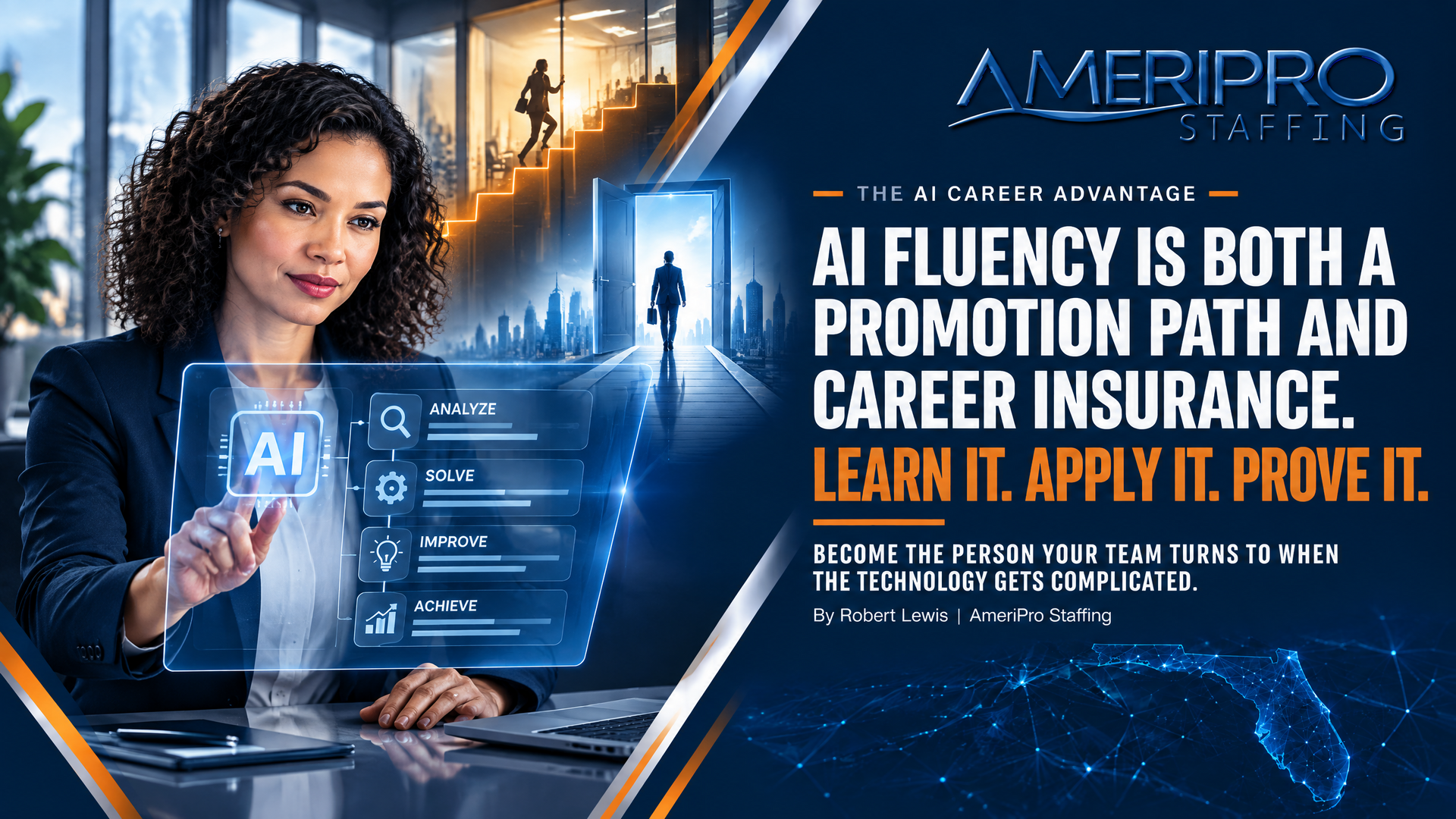
If you're an employee, the move is simple: don't wait for your company to hand you an AI strategy — build your own. Learn the tools relevant to your field, get a certification that proves it, and become the person your team turns to when the technology gets confusing. If you're a job seeker, that same experience is now one of the fastest ways to stand out in a crowded field.
And if you're the one making the headcount decisions, resist the urge to move faster than your evidence supports. AI is going to change the shape of a lot of jobs. Used right, it doesn't eliminate the people who make a company work — it elevates them.
That's the difference between a company that survives this shift and one that just reacts to it.